
The Tube Wars: K3-EDTA vs. Cell Stabilization Tubes
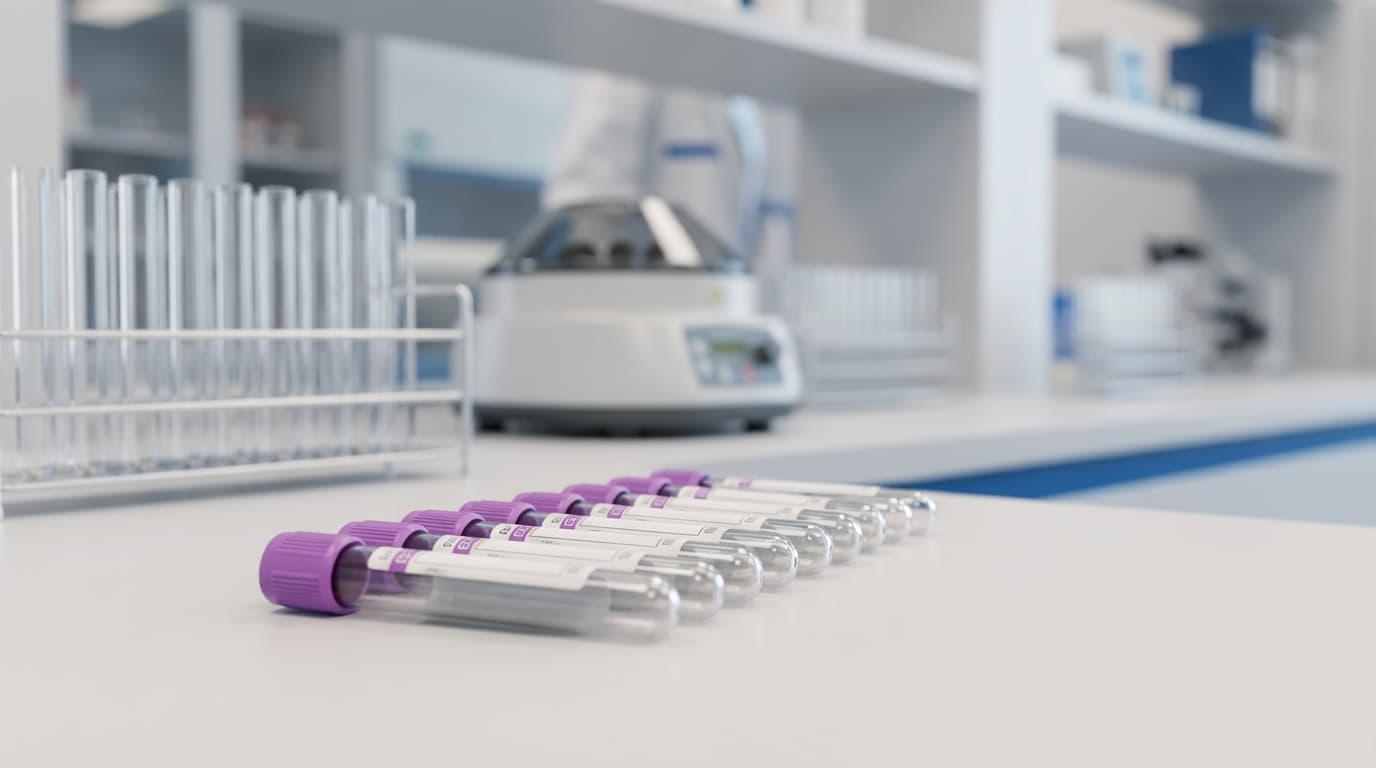
Why does a $0.50 tube ruin a $300 test? We break down the chemistry of EDTA vs. Streck tubes and help you decide which one your clinic needs.
The Tube Wars: K3-EDTA vs. Cell Stabilization Tubes
If you look at the catalog for a veterinary reference lab offering liquid biopsy, you will often see two options for sample submission: "Frozen Plasma" or "Stabilized Whole Blood."
This choice dictates which blood tube you grab: the standard purple-top EDTA or the specialized (and often camouflage-patterned) Streck Cell-Free DNA BCT.
Why does it matter? Why can't you just mail the purple top?
The Purple Top: K3-EDTA
The Mechanism: EDTA acts by chelating calcium. Calcium is a cofactor for the coagulation cascade (preventing clots) and also a cofactor for DNase enzymes. By binding calcium, EDTA stops clotting and slows down DNA degradation.
The Failure Mode:
EDTA does not feed or preserve the white blood cells (WBCs).
1. Draw Time: WBCs are alive and happy.
2. T+4 Hours: At room temperature, glucose runs out, metabolic stress sets in, and WBCs begin to die (apoptosis).
3. T+8 Hours: WBC membranes rupture (lysis).
4. T+24 Hours (Mailing): The tube contains a soup of genomic DNA from billions of lysed WBCs.
The Result: The trace amount of tumor DNA you wanted to measure is now diluted 10,000:1 by healthy DNA. The test is useless.
Verdict: Use EDTA only if you can spin and separate plasma within roughly 2 hours of the draw.
The Specialist: Cell Stabilization Tubes (Streck)
The Mechanism:
Streck tubes (and competitors like PAXgene ccfDNA) contain a proprietary preservative agent—often a formaldehyde-releasing compound or similar non-crosslinking fixative.
This preservative penetrates the WBCs and "freezes" them in time. It toughens the cell membrane, preventing lysis even under stress (like the bumping of a delivery truck).
The Specs:
* Stability: Maintains sample integrity for 7 to 14 days at room temperature (6°C to 37°C).
* Safety: Prevents genomic DNA release, keeping the plasma "clean" for analysis.
The Catch:
1. Cost: These tubes cost significantly more ($10–$15 per tube) than EDTA ($0.50).
2. Fill Volume: They rely on a specific ratio of blood to preservative. You cannot "short draw" them. If a tube requires 10mL, you need to get 10mL, or the chemistry won't work.
3. Temperature: You cannot freeze whole blood in a Streck tube. Freezing causes ice crystals that rupture cells despite the preservative. If you freeze a Streck tube, you ruin it.
Decision Logic: Which to Choose?
* Scenario A: The 4 PM Friday Draw.
Problem:* Courier has already left.
Choice:* EDTA. Spin it down immediately, harvest plasma, and freeze the plasma. Plasma is stable frozen for months.
* Scenario B: The Ambulatory Horse Vet.
Problem:* You are in a barn, 2 hours from a centrifuge.
Choice:* Streck. Draw the blood, keep it at ambient temp in your truck, and ship it whenever you get to a post office. No spinning required in the field.
* Scenario C: The High-Volume Clinic.
Problem:* Busy techs, "stat" spins are disruptive.
Choice:* Streck. It buys you time. You can draw at 9 AM and spin at 5 PM without data loss.
Summary
* EDTA: Requires speed (process <4h). Cheap.
* Streck: Buys time (7+ days). Expensive. DO NOT FREEZE.
Choose the tube that fits your workflow, not just your budget. A cheap tube that yields a failed test is the most expensive option of all.